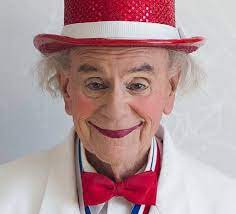
A Life Lived Beneath the Canvas Sky
Born Into Sawdust and Stardust
Long before Jackie LeClaire ever painted his face or stepped into the spotlight, the circus had already claimed him. He was born into a world where mornings smelled like hay and greasepaint, where nights were lit by lanterns swinging from tent poles, and where every day promised a new town, a new crowd, and a new chance to make someone smile. For Jackie, the circus was not just a job. It was the family business, their home, and a legacy he carried his whole life. He was destined to become one of the last great clowns of the American traveling circus, a performer whose life spanned eras of spectacle, tragedy, reinvention, and quiet devotion.
The Child of the Circus
Jackie LeClaire entered the world on May 11, 1927, in Sarasota, Florida. Back then, Sarasota was the beating heart of Ringling Bros. and Barnum and Bailey. His parents, Jack and Edna, were nomadic performers who lived the life of circus artists. Jackie’s earliest memories were not of playgrounds or classrooms; they were of wagons, tents, and watching performers practice in the morning sun. By the time he was two, Jackie was already in the show. His father dressed him in miniature costumes and taught him the basics of clowning. Jackie did not just learn to perform; he learned to live as a performer.
But childhood under the big top had its dark moments. In 1936, Jackie’s mother passed away, leaving him and his father to navigate the circus world on their own. For a brief period, he tried a more traditional life, going to school and staying in one place. But the circus had already shaped him. The stillness of ordinary life felt foreign and empty. He eventually returned to the road and never really left it again.
The Ringling Years and the Fire That Changed Everything
In 1944, at just seventeen years old, Jackie joined Ringling Bros. and Barnum and Bailey. It was the most prestigious circus in the world, a total dream come true. But that dream was met with one of the darkest days in circus history.
The Hartford Circus Fire
On July 6, 1944, during a packed matinee in Hartford, Connecticut, the tent caught fire. The blaze spread with terrifying speed. The canvas had been waterproofed with a mix of paraffin and gasoline, which was common at the time, but it essentially turned the tent into a massive candle. The fire killed nearly 170 people and injured hundreds more. Jackie survived, but the tragedy left a permanent mark on him. He carried the memory of that day for the rest of his life, always speaking of it with reverence and a deep sorrow. Yet he kept performing. He believed that laughter was a way to heal, both for himself and for the audiences who needed joy after the war years.
The Aerialist Behind the Hollywood Curtain
Though most knew him as a clown, Jackie was also a skilled aerialist. His agility earned him a unique gig: serving as a body double for actor Cornel Wilde in Cecil B. DeMille’s film The Greatest Show on Earth in 1952. Jackie performed the aerial stunts that Wilde’s character was supposed to execute. Hollywood wanted authenticity, and Jackie delivered it, helping shape one of the most iconic circus films ever made. But despite his talent in the air, his heart always belonged to clowning.
The Clown Who Traveled the World
During the 1950s and 60s, Jackie traveled internationally with various shows. His performances took him to Cuba, South America, Europe, and even the Soviet Union. He performed for crowds who spoke dozens of different languages, but he found that laughter needed no translation. Jackie believed clowning was universal, a bridge between cultures. His clown persona was gentle and deeply human. He did not rely on loud antics or heavy makeup. Instead, he used subtle gestures, soft humor, and emotional storytelling, a style that felt more like European pantomime. Audiences loved him for it.


Reinvention, Mentorship, and Giving Back
In 1964, Jackie left Ringling but stayed close to the circus world. He performed at fairs and thrill shows while reinventing himself as a licensed hairdresser, a trade he practiced while still teaching young performers. Jackie became a respected mentor at clown camps and competitions. He truly believed clowning was an art form that required discipline, empathy, and a real understanding of human emotion.
But perhaps his most meaningful work happened later in life.
Laughter Unlimited
For more than twenty years, Jackie volunteered with Laughter Unlimited, a program that brought joy to nursing homes. He visited elderly residents, many of whom rarely had visitors, and performed gentle routines that reminded them of childhood and hope. He did not do it for the applause; he did it because he believed laughter was just another form of love.
The Quiet Philosophy of a Circus Man
As Jackie grew older, he became something rare: a performer who understood that clowning was not just entertainment, but a philosophy. To Jackie, it was a way of seeing the world, a commitment to gentleness and the belief that every person deserves a moment of joy. He often said that a clown’s job was not necessarily to be funny, but to be kind.
This belief shaped every move he made. Jackie never chased laughs with chaos or noise. Instead, he used small gestures, a tilt of the head, a slow blink, or a soft smile, to create humor that felt warm. His style was intimate, almost tender, and it made people feel like he was performing just for them. In an era when circus acts were getting louder and more extreme, Jackie remained a quiet reminder of the art’s roots. He represented the old world clown: the storyteller and the gentle fool.
The Circus Changes, but Jackie Endures
By the 1970s and 80s, the American circus was changing. Television and theme parks were pulling audiences away from the big top. Many performers retired, and some circuses folded entirely. But Jackie stayed. He performed at smaller shows and county fairs, places where the circus still felt personal. He did not need a massive tent; he only needed a handful of people willing to laugh.
Jackie became a living bridge between generations. Older fans remembered him from the Ringling days, while younger fans saw him as a relic of a magical world they would never fully know. He carried the history of American circus culture in his posture and his stories, and he shared those stories freely. He spoke of the old circus trains, the camaraderie between performers, and the thrill of opening night. He spoke of the Hartford fire with reverence, never trying to make it a spectacle, but always honoring the lives lost. Jackie was not just a performer; he was a historian.
The Mentor Behind the Makeup
As he aged, Jackie shifted naturally into the role of mentor. Young clowns sought him out, eager to learn the subtleties of his craft. Jackie taught them that clowning was not about tricks or props; it was about heart. He emphasized softness over slapstick and connection over chaos. He taught that a clown’s face paint should reveal something about them, not hide who they were. To him, the best clowns were those who understood people deeply.
His influence went beyond the ring. As a hairdresser, Jackie spent hours talking with clients and listening to their stories. He believed that every interaction, whether on a stage or in a salon chair, was a chance to make someone feel seen.
Laughter Unlimited and the Power of Joy
In his later years, Jackie devoted himself to Laughter Unlimited. For more than two decades, he visited nursing homes to see residents who were often lonely or forgotten. He performed simple routines, a dropped handkerchief or a shy wave, but the impact was profound. Residents who rarely spoke would smile again. Jackie believed that laughter could heal in ways medicine could not. He did not perform for the applause; he performed for the connection. These visits were quiet acts of service that never made headlines but changed lives. Jackie often said these were his favorite audiences. They did not need a spectacle; they just needed kindness.
The Final Bow
When Jackie LeClaire passed away in 2019, the circus world mourned more than just a performer. They mourned an era. Jackie represented the last generation of clowns who lived entirely within the traveling circus tradition. His legacy lives on in the performers he mentored, the traditions he preserved, and the philosophy of gentle clowning he lived by. Jackie’s life reminds us that the circus is about community and humanity. It is a place where people share wonder. And at the center of that wonder, for decades, stood Jackie LeClaire, the quiet clown with a soft smile and an enormous heart. He did not chase fame or glory. He just wanted to make people happy. And he succeeded.
Leave a Reply